

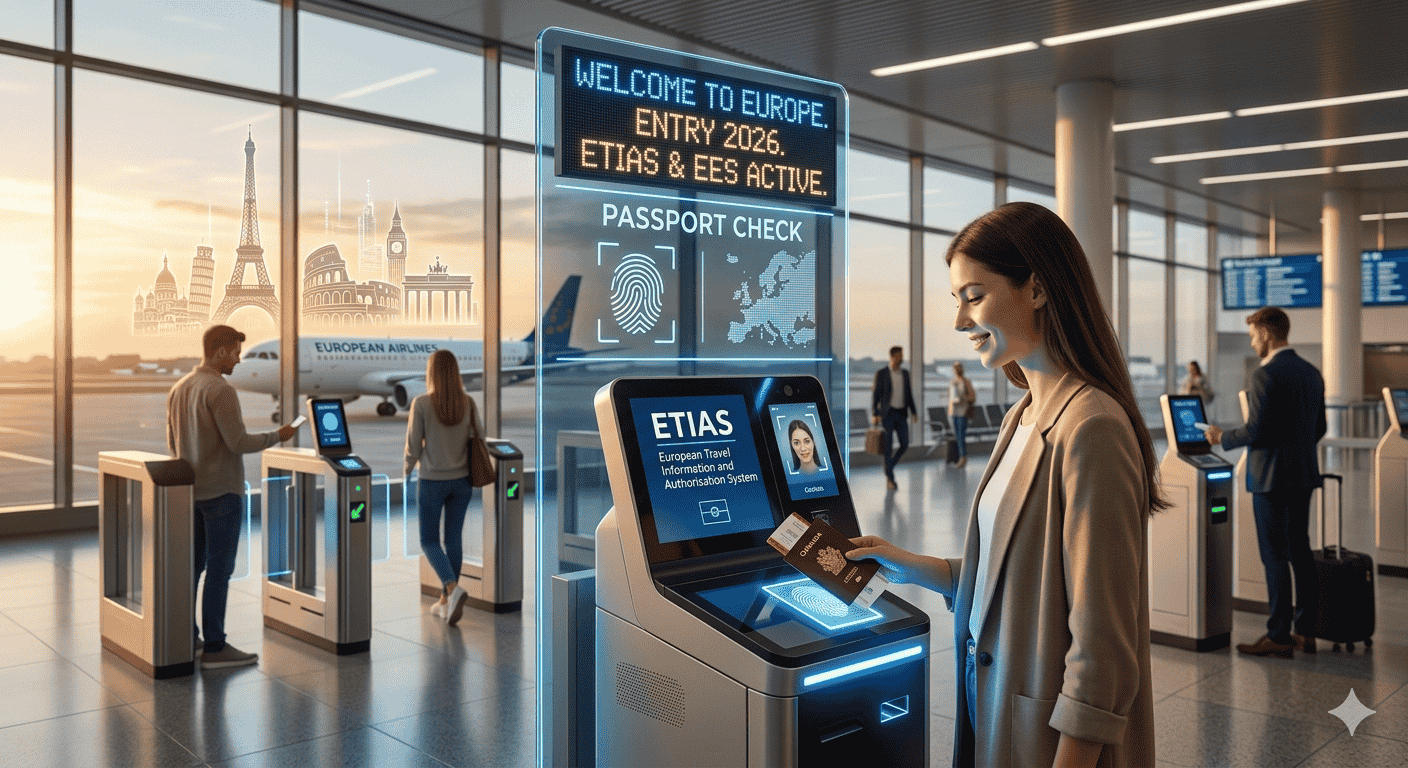
The landscape of European travel has undergone its most significant transformation in decades. As of May 2026, the days of manual passport stamps and paper-heavy applications are fading into history. For travelers planning a getaway to the Eiffel Tower, the canals of Venice, or the fjords of Norway, understanding the updated European visa requirements is no longer just helpful—it is essential for entry.
This year marks the full operational status of high-tech border systems designed to make travel more secure and, eventually, much faster. Here is everything you need to know about the 2026 digital border shift.
1. The Death of the Passport Stamp: EES is Live
On April 10, 2026, the European Union officially transitioned to the Entry/Exit System (EES). This is a massive shift for all non-EU travelers.
What is the EES?
The EES is an automated IT system that registers travelers from “third countries” (non-EU/Schengen) each time they cross an external border. Instead of a border officer searching for a blank page to stamp, your data is now captured digitally.
- Biometrics: You must provide fingerprints and a facial image upon your first entry.
- Validity: This data is stored for three years, making subsequent trips much faster as you can use automated kiosks.
- Overstay Tracking: The system automatically calculates your 90-day allowance. The “90/180 day rule” is now enforced by an algorithm, leaving zero room for accidental overstays.
For official technical specifications on how your data is handled, you can refer to the European Commission’s Migration and Home Affairs portal.
2. ETIAS: The New Requirement for Visa-Free Travelers
If you hold a passport from a country like the United States, Canada, Australia, or the UK, you previously traveled to Europe visa-free. While you still don’t need a traditional visa, the European Travel Information and Authorisation System (ETIAS) is now mandatory.
ETIAS Essentials for late 2026:
- Who needs it? Citizens of over 60 visa-exempt countries.
- Cost: €7 for adults (free for those under 18 or over 70).
- Validity: Valid for 3 years or until your passport expires.
- Purpose: It is a pre-travel screening to identify security or health risks before you reach the border.
Travelers are urged to apply only through the Official ETIAS Website to avoid fraudulent third-party sites charging exorbitant “service fees.”
3. European Visa Requirements: The Digital Shift
For travelers who do require a traditional visa (such as citizens from India, China, or South Africa), the process has moved toward the EU Visa Application Platform (EU VAP).
Updated Fees and Forms
As of January 1, 2026, the standard Schengen visa fee (Type C) is set at €90 for adults and €45 for children aged 6–12. While the EU is transitioning to a fully digital “e-visa” (replacing the physical sticker with a secure 2D barcode), the roll-out is gradual.
Standard Documentation Checklist:
- Digital Application: Completed via the EU VAP or national portals.
- Passport: Must be issued within the last 10 years and valid for at least 3 months beyond your planned departure.
- Travel Insurance: Must cover at least €30,000 for medical emergencies and repatriation.
- Proof of Subsistence: Evidence that you have enough funds for the duration of your stay.
Detailed financial requirements can vary slightly by the country of entry. For example, the French Ministry for Europe and Foreign Affairs provides a specific breakdown of required daily funds.
4. Understanding the 90/180 Rule in the Digital Age
The most common reason for entry refusal or future visa denials in 2026 is a violation of the short-stay rule. You can stay in the Schengen Area for a maximum of 90 days within any 180-day period.
With the EES now fully functional, the “rolling window” is tracked to the second. If you visit Italy for 30 days, leave, and return 2 months later, the system knows exactly how many days you have left.
Expert Tip: Use the official Schengen Calculator provided by the European Commission to plan your trip and avoid being flagged as an “overstayer” in the new database.
5. Travel to Non-Schengen European Countries
It is a common misconception that all of Europe follows the same rules. In 2026, the distinction remains critical:
Region | Visa/Entry System | Examples |
|---|---|---|
Schengen Area | EES / ETIAS / Schengen Visa | France, Germany, Spain, Greece |
Cyprus | National Visa (ETIAS required later) | Cyprus |
Ireland | Irish National Visa / Irish Stamp | Republic of Ireland |
United Kingdom | UK ETA / Standard Visitor Visa | England, Scotland, Wales |
For those crossing between the UK and the EU, remember that the UK has its own Electronic Travel Authorisation (ETA). You can check your eligibility on the UK Government’s official visa site.
6. How to Prepare for Your 2026 Trip
To ensure a seamless entry into Europe, follow this 2026 readiness checklist:
- Check Passport Dates early: The EES system is sensitive to passport validity. Ensure you have at least 6 months of validity to be safe, even though the law requires 3.
- Apply for ETIAS at least 96 hours before travel: While most applications are approved in minutes, some may take up to 30 days if manual review is required.
- Prepare for Biometrics: Be ready for a slightly longer wait at the border during your first 2026 entry as your fingerprints and photo are registered.
- Keep Digital Copies: While the system is digital, having a PDF of your ETIAS approval or visa on your phone (and a paper backup) is a smart fail-safe.
Summary: A More Secure Europe
The 2026 European visa requirements are designed to modernize a system that was previously reliant on ink and paper. While the initial registration in the EES might take a few extra minutes at the airport or ferry terminal, the long-term benefit is a “frictionless” border experience for frequent travelers.
By staying informed through official government channels and respecting the digital stay-limits, you can focus on what really matters: enjoying the rich culture, history, and landscapes that Europe has to offer.
READ MORE: jobs in eu